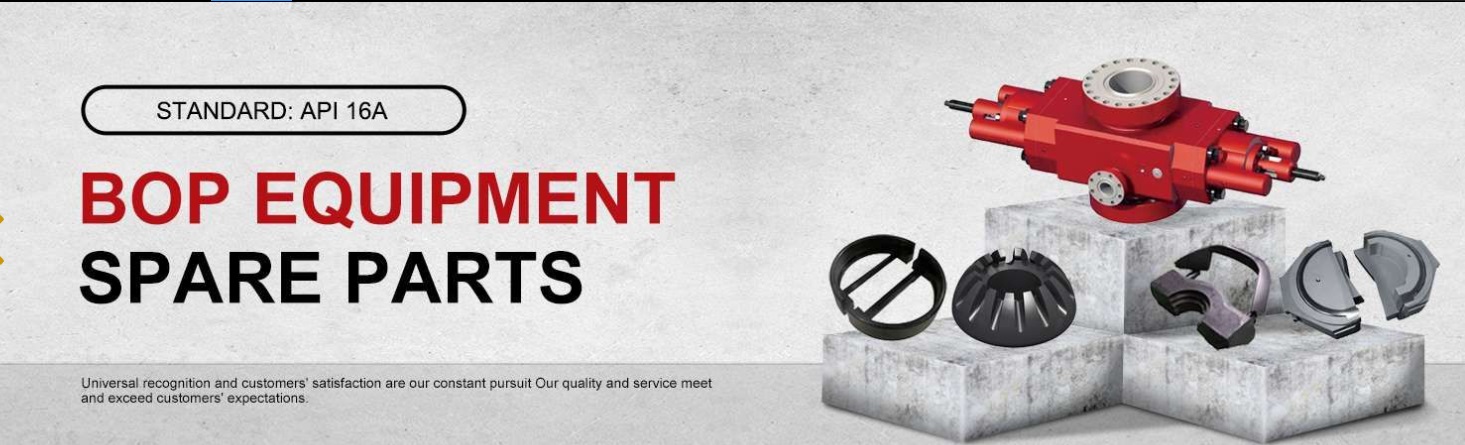
The ram blowout preventer is one of the key elements of the well control system. It is mainly used to control the well head pressure during such operations as drilling, servicing and oil testing to prevent any blow out hazard effectively and ensure safe operations. Specifically, it can be used for the following operations:
² When there is a pipe string a well, the circular space between the casing and the drill pipe could be
sealed with matched pipe rams.
² When there isn’t a pipe string in a well, the wellhead could be shut off completely with blind rams.
² After the well has been sealed, such special operations as mud circulation, choking, killing and well
washing can be performed through choke and kill manifold connected to spool and side outlet of BOP.
² When used together with the pipe manifold for choking and killing, it can control the well pressure
effectively and achieve near-balance well killing operations.
2. Technical Parameters
2.1 Explanation of Ram Blowout Preventer
2.2 Technical Parameters of the Ram Blowout Preventer
3. Working Principles
3.1 Principles of opening and closing
When high pressure oil of hydraulic control system comes into the left and right closing chambers of cylinders through oil channel inside body from hydraulic port, the impelling pistons drive ram shafts with ram assemblies to the center of wellhead along ram chamber to close the well. When high pressure oil comes into the left and right opening chambers of cylinders, the impelling pistons drive the ram shafts with ram assemblies away from the center of the wellhead to open the well. The opening and closing is controlled through the reversal valve of the hydraulic control system.
3.2 Principles of well pressure sealing
A ram blowout preventer can only effectively close a well when all the four seals have taken effect. These four seals include the seal between the ram top seal and the body, the seal between the ram front seal and the pipe, the seal between the body and the bonnet, and the seal between the ram shaft and the bonnet.
The ram sealing process is divided into two steps. In the first step the hydraulic oil forces the ram shaft to impel ram packer to deform and seal the front part, and top seal seals top with compressed rubber, so it establishes a primary sealing. In the second step, with the help of the pressure inside the well the rams are impelled from behind to make ram packer deform more and the rams are also impelled from the bottom to let the body adhere tightly to top, thus achieve the reliable sealing. It is called the well pressure assisted sealing effect.
4. Structures and features
4.1 Structural Features
Ø Such major pressure bearing components as body, bonnets and ram blocks are cast formed with alloy steels of high strength and high malleability, and properly heat treated. And the water pressure test for strength is performed before ex factory according to API specifications.
Ø At the bottom of ram chamber, there are high brace rods and sand-depositing slots towards the well bore. So the sands and silts will be removed automatically when the rams’ opening and closing. It reduces the kinetic frictional resistance of the ram, and is also helpful to the well pressure assisted sealing of the ram. The surface of ram chamber is smooth and easy to clean.
Ø A kind of floating ram sealing is adopted to reduce the resistance in opening or closing the ram, minimize the wearing of the rubber elements and lengthen the service life of the ram. It also prevents the body and ram from rusting together and thus is easy to disassembly.
Ø The ram shaft retainers are made of stainless steel, and retainers’ grooves are lined with stainless steel. The BOP is of high anticorrosive ability.
Ø The top seal surface of ram chamber is chemically coated with nickle for anticorrosion.
Ø Rams are HF type which is easy to change and maintenance.
Ø The internal parts and surfaces of BOOP contacting with well fluids are resistant to the corrosive stress of hydrogen disulfide and conform to the requirements specified in NACE MR-0175.
Ø The dimensions of the external connections are in conformity with the API 6A.
4.2 Pipe Ram
4.4 Emergency Sealing Device
The sealing structures between ram shaft and bonnet are divided into two parts, one is for the sealing of well pressure and another is for the sealing of the oil pressure of the hydraulic control system. The emergency sealing device is located between these two parts. In general, the sealing at this part is very reliable because of multiple seal rings and auxiliary sealing of the O ring in the middle. However, in some cases the seal rings here are damaged because of long time of lacking of maintenance or other reasons. The leakages may be observed when closing a well and in this case the emergency sealing device is then needed to deal with this kind of emergencies.
If leaking liquid is observed from the inspection hole (below the bonnet) when closing a well, it indicates that seals are damaged. Which seal is failed between well pressure side and oil pressure could be judged from the leaking liquid material (water or oil). At this time immediately loosen the NPT 1” pipe plug, take out the clinch nut, and inject emergency ester bar sealing grease into the annular sealing space of the ram shaft through the check valve and the radial hole of the sleeve to repair the sealing.
Cautions of emergency sealing:
Ø In order to prevent the secondary sealing grease from solidifying and becoming invalid when the blowout preventer is not used for a long time, the emergency sealing grease is not injected when the blowout preventer is released from the factory. And it’s not recommended to inject it when blowout preventer is not in use. It will be injected just before blowout preventer is used in wellsite and it will be taken out after the completion inspection and the relevant parts should be well cleaned.
Ø The special tools should be prepared at hand for cases of emergency.
Ø The pipe plug (with a small hole on it) of the inspection hole at the lower part of the blowout preventer should be inspected periodically during operations to see whether there are any leakages of well liquids or oil.
Ø When a seal ring fails, the injected emergency sealing grease’s amount should not be too much. The appropriate amount should be the one when no further leakages are observed at the inspection hole. The severe frictional resistance of emergency sealing grease with grains will damage ram shaft in back stroke.
Ø Examine and repair blowout out preventer immediately after using emergency sealing, wash grease at once to prevent from drying in injection hole.
4.5 Locking shaft sealing mechanism
4.6 Ram manual locking mechanism
Manual locking mechanism consists of locking shaft, ram shaft, manual operating assembly. It closes and locks rams by the hand wheel. Its application is to seal the well for a long time and lock rams in closing position after close rams with hydraulic system. At this time, hydraulic pressure can be released. After closing the rams with hydraulic pressure, turn hand wheel to the right, drive locking shaft rotating through operating rod. Because locking shaft shoulder presses against locking shaft housing, it cannot go back, thus it can only drive ram shaft to move toward wellhead center and then lock rams. Manual locking mechanism can only close ram, it’s not able to open ram. If you want to open the rams closed by manual system, you must unlock the system to original position and then open the ram with hydraulic pressure. It is the only method to open the rams. The operation procedure is as following:
a. Turn the hand wheel to the left until dead end, then turn back 1/8-1/4 circle to avoid the locking shaft from blocking at the unlocking position because of temperature change.
b. Open the rams with hydraulic pressure.
5. Parts list
6. Installation, application and cautions
Before installing the blowout preventer please make sure that you have read the above chapters of this manual, where the structures, functions and operation methods of each component of this blowout preventer are described in detail. Then you can install and use this blowout preventer following the procedures described below.
6.1 Installation on the Wellhead
6.1.1 The following checks shall be performed before installing this ram blowout preventer:
(1) Check the integrity of the circle slot for the seal gaskets of the flanges of the wellhead and the blowout preventer and check that there are no bulging points on the surfaces of the flanges.
(2) Check whether the specifications of rams in BOP are compatible with the dimensions of the drilling tools in the well.
(3) Check that it passed the pressure test.
6.1.2 Installation of the Ram Blowout Preventer
(1) Tighten the coupling bolts of each flange homogenously cornerwise one by one. Please see Table 11 or Table 12 for the tightening torque of the bolts of each flange.
(2) Connect the hydraulic control line and pay attention to the marks for the open and closure of the blowout preventer.
(3) Connect the manual control rods.
6.1.3 After the ram blowout preventer is installed at the wellhead, the following inspections shall be performed before use. And a trial run shall be performed and start using it only after it has been confirmed that there are nothing faulty in its operation.
(1) Check the Correct Installation of the Blowout Preventer: The hoisting rings of the body shall be on the top. The manual locking device shall be completely installed, well fixed and a label indicating the number of circles needed for the opening and closing operation shall be attached to the hand wheel. All the coupling bolts shall be homogenously tightened cornerwise one by one.
(2) Check whether the oil circuit connection pipe lines are in accordance with the label for the opening and closing of the blowout preventer. The various kinds of ram can be opened and closed twice in trial under a control pressure of 2 to 3MPa by the control console to expel the air inside the oil line. Adjust the connection pipeline if the open and closure of the rams are not in conformity with those indicated on the handle of the control console.
(3) Check the connection of the manual locking device to see whether the manual lever can freely control the opening and closing of the ram and note down the number or circles of the hand wheel needed to close the well and indicate it on the label of the hand wheel. After finishing the test rotate the hand wheel to the left back to the unlocked position and hydraulically open the ram.
(4) Perform a complete pressure test for the devices at the wellhead, and the standards for the pressure test shall be in accordance with the relevant well control procedures and regulations. Check the tightness of all the connection bolts once again after the pressure test to prevent any non-uniformity in tightness. The tightening moments of the bolts of the flanges are listed in table 11 or table 12.
6.2 Uses
A dedicated person should be appointed to be responsible for BOP and the responsibilities should be defined clearly. The operator should have the knowledge concerning working principles, performances and the process, and should be able to operate, maintain, service and debug it also.
When testing the closure of the pipe ram, if there is not any pipe strings in the well the maximum hydraulic control pressure shall not exceed 3MPa to avoid damaging the rubber elements. When there is a pipe in the well it is strictly forbidden to close the blind ram.
When it is needed to close a well for a long time, the ram shall be locked with the manual locking device and a label shall be attached at the control console indicating the actual situation to avoid any incorrect operations.
After entering the target layer, the ram shall be opened and closed once a day to check whether it can be opened or closed smoothly and whether the manual locking device is in good service. The open and closure of the blind ram shall also be tested after each pulling out operation. It is strictly forbidden to close the blind ram when there are some pipes inside the well.
6.2.1 Ram Sealing Test
The testing media shall be clean water or drilling fluid. During the pressure test the timing shall be started after the pressure has been stabilized.
(1) Testing of Blind Ram and Pipe Ram
Testing Procedures:
A. Install blowout preventer on the seat of the testing stump and connect opening and closing pipe lines to the preventer. Connect the pipe lines from high pressure test pump to the seat of the testing stump or the side outlet of the blowout preventer.
B. When testing the pipe ram, install the testing mandrel in the blowout preventer and ensure that the mandrel is reliably connected to prevent it from breaking off during the test. No mandrels are needed when testing the blind or shear ram.
C. Close the ram hydraulically at a pressure of 8.4 to 10.5MPa (1,200psi to 1,500psi) with the hydraulic control handle at the closing position.
D. Improve the testing pressure to 1.4MPa to 2.1MPa (200psi to 300psi) and hold this pressure for 10 minutes. Check if there are any leakages. It is qualified if there is no any leakage.
E. Improve the testing pressure to the maximum working pressure of the blowout preventer, and hold this pressure for 10 minutes. It is qualified if there is no any leakage.
F. Reduce the well pressure to zero.
For a variable bore ram, its maximum and minimum drill pipe should be tested separately following the same testing procedures described above. For a variable bore ram it could not be closed manually and the well can only be closed hydraulically.
(2) Testing of the locking mechanism:
A. Close the ram hydraulically at a pressure of 8.4 to 10.5MPa (1,200psi to 1,500psi).
B. Rotate the locking shaft manually clockwise to lock the ram.
C. Reduce the hydraulic control pressure to zero and leave the hydraulic control handle at the ram closing position.
D. Increase the testing pressure to 1.4MPa to 2.1MPa (200psi to 300psi) and hold this pressure for 10 minutes. It is qualified if there is no any leakage.
E. Increase the well pressure to the maximum working pressure of the blowout preventer, and hold this pressure for 10 minutes. It is qualified if there is no any leakage.
F. Reduce the well pressure to zero, rotate the locking shaft counter clockwise to unlock it. After unlocking rotate it backward for 1/8 to 1/4 circles.
G. Open the ram hydraulically.
6.2.2 Testing of the Hydraulic Control System
The rated working pressure of the hydraulic control system of the blowout preventer is 21MPa (3,000psi). The opening and closing should be tested separately. The testing media is the hydraulic oil.
A. without rams or bonnet is rotate to the open position. Pay attention not to let the ram shaft touch the body when it is protruded. The blowout preventer should be fixed to ground to prevent it from falling because of the shift in the center of gravity after the two bonnets have been opened at the same time.
B. Perform the testing of the closure chamber under a pressure of 21MPa (3,000psi) and hold this pressure for 10 minutes. It is qualified if there is no any leakage.
C. Reduce the hydraulic control pressure to zero.
D. Perform the testing of the opening chamber under a pressure of 21MPa (3,000psi) and hold this pressure for 10 minutes. It is qualified if there is no any leakage.
E. Reduce the hydraulic control pressure to zero.
6.3 Precautions
1. It is forbidden to release the pressure by opening the ram to avoid damaging the rubber elements. Check whether the manual locking device has been unlocked every time before opening the ram. After opening, the rams should be checked whether they are fully opened (drawn back completely inside the body) to avoid damaging the ram by the drilling tools.
2. It is forbidden to rotate the drilling tools when the ram is closed.
3. Pay attention to keep the hydraulic pressure oil clean.
4. After using or testing the blowout preventer, the water inside it shall be completely drained. The ram shall be kept at the fully opened position, and rust-proofing measures shall be taken.
7. Maintenance and Servicing
The blowout preventer shall be thoroughly cleaned and inspected after serving each well. Damaged parts shall be replaced in time, ram chamber and ram assembly shall be coated with rust proof oil (aluminum base grease is recommended). All rust proof oil should not melt under 50℃; all threads should be coated with thread oil.
7.1 Replacement of the HF type rams and ram rubbers
The ram sealing rubber elements are the key components for the successfully well closing. It is impossible to use once it is damaged. So they should be kept intact without any defects. Once a defect is found it should be replaced in time. The procedures for the replacement of the ram and the ram rubbers are as follows:
▲!Pay attention to make sure that the manual locking device is in the unlocking position.
(1) Open the rams fully hydraulically.
(2) Take out ram assemblies out by drawing horizontally from the tail of the ram shaft. Pay attention to protect the sealing surface, the ram, ram shaft and bonnet from being knocked or scratched. Note: Before the blowout preventer is fixed, it is forbidden to open both sides of bonnets at the same time to prevent the blowout preventer from falling because of the gravity center’s shift.
(3) When replacing the rubber element of the ram, first pry the top seal, then dismount the packers, and replace it with a new one. Repeat the above procedures reversely to assemble it.
7.2 Servicing the bonnet hinges
The hinge of bonnet is the rotating shaft of the bonnet as well as the channel for the hydraulic oil. Leakages of oil will occur if the seal ring is damaged. Then it shall be disassembled and checked following the specific procedures below.
1. First make sure that the bonnet and the body are firmly connected.
2. Dismount the two positioning pins on the hinge and then dismount the four coupling bolts. (Note: the positioning pins are separation structures and they can be pulled out with a M8 screw.)
3. Take the hinge down from the bonnet and it could be hit gently with bronze hammer. It is forbidden to apply too much force to avoid damaging the sealing surfaces.
4. Check the O rings on the hinge and replace all the O rings as much as possible. Check whether there are any scratches on the sealing surface and repair them if necessary.
5. The connection surfaces should be coated with lubricant when installing. Hit it gently into the bonnet and pay attention to the position of the position holes. First mount the two position pins and then mount the four bolts.
7.3 Servicing the Hydraulic Cylinder Assembly
If there are any damages or leakages of oil at the ram shaft sealing, the piston sealing or the locking shaft sealing, they should be disassembled and repaired. The specific procedures are described below.
7.3.1 Procedures
1. Open rams to full opening hydraulically first. If the bonnet is opened, it should be closed, at least mount each bonnet bolt at opposite corner and then open the ram hydraulically.
2. Place a clean oil basin below the cylinder to prevent the oil from leaking onto the ground during the dismounting operation.
3. Dismount the studs and nuts on cylinder and then dismount locking shaft and locking shaft housing.
4. Turn the locking shaft reversely, and take out it from ram shaft.
5. Take down the cylinder.
6. Loosen the lock screw (No. 17) in the lock nut of piston.
7. Dismount the lock nut of the piston and take down the piston.
8. Open the bonnet, take down the ram and draw out the ram shaft.
9. Dismount the retainer; take out ram shaft and the seal ring and the seal ring of the locking shaft inside the locking shaft housing with the same method.
7.3.2 Inspection sites after dismounting
(1) Inner wall of hydraulic cylinder
If there are any deep longitudinal scratches in the inner surfaces of the hydraulic cylinder and leakages cannot stop even after replacing the seal ring of the piston, it shall be replaced with a new hydraulic cylinder. And at the same time such related components as the piston shall be inspected to find out the causes of the scratches and solve them. If the scratches are shallow linear or spot scratches, they can be repaired with a piece of very fine sand paper or an oil stone.
(2) Sealing surface of ram shaft and locking shaft
If there are any scratches on the sealing surface, the same judging and treatment methods as those for the hydraulic cylinder shall be used. If the coating material is scaled off it would cause serious leakages and it must be replaced by a new one.
(3) Seal Ring
First check whether there are any abrasions at the lip of the sealing element and whether there are any cut damages resulted from extrusions. The sealing element is preferred to be replaced if there are any mild damages or abrasions.
(4) Piston
The piston shall be replaced if it is with an inhomogeneous abrasion deeper than 0.2mm at the moving sealing surface. And there shall not be any defects that can affect the sealing performance on other surfaces.
7.3.3 Installation of cylinder assembly
1. Repeat the dismounting operations reversely to mount the hydraulic cylinder and pay attention to the following points.
2. Check whether there are any burrs or cusped edges on the components and remove them if there are any to protect the lips of the seal rings from being scratched. Pay attention to keep them clean.
3. When installing the seal ring, its surface shall be covered with lubricant and the corresponding sealing surface shall also be covered with lubricant to facilitate the mounting operation.
4. Pay attention to the direction of the lip seal to make sure that the opening of the lip shall be pointed to the pressure side.
5. Take care to allow the seal ring to pass through the threaded parts smoothly and avoid any scratches.
6. Pay attention to the installation position of locking nut. Piston should contact the chamfer of ram shaft without space. Locking nut should be punched tight, and then screw locking screw.
8. Proper storage of rubber parts
The storage condition will influence rubber parts’ service life greatly. The perfect storage condition is a cool, dark and dry warehouse and the rubber parts should be packed in bags. All rubber parts should be stored as following if you do not have perfect conditions:
1. Always use the oldest rubber part first. New parts should be placed at the back of the bin, so that old parts will be used first.
2. Definitely do not store rubber parts out of doors. Rubbers should be stored in dark, cool (0-25ºC) and dry room (humidity is less than 80%). Keep them away from heaters and direct sunlight
3. Do not spill corrosive material on rubber parts; Keep storage area as cool as possible. Never store rubber parts near heaters, steam pipes, radiators or other hot equipment.
4. Store these items away from high-voltage equipments. High-voltage equipment frequently produces ozone that attacks rubber.
5. Rubber parts should be placed in a relaxed position. Do not bend, extrude or hang them. For example, bending a rubber part and forcing it into a small box will accelerate aging the stressed area.
6. Check rubber parts often, the parts with brittleness, crackle, bending should be abandoned.
7. Generally the storage period is 2 years.
Name: Steven
Mobile:+8615369805074
Whatsapp:+8613512492572
Email:sales@fengliangpetroleum.com
Add:Binhai New Area, Tianjin City